Electric Gate Opener Troubleshooting: Battery, Sensor, and Motor Fixes
Your gate was fine yesterday. Today the remote clicks, the gate stays shut, and your car is stuck in the driveway. Before you call anyone, a few minutes of electric gate opener troubleshooting can tell you whether this is a dead battery, a blocked sensor, or a motor that has reached the end of its life. This guide walks through the checks in the order a technician would run them, so you know what you can fix yourself and when to pick up the phone for gate repair.
Work through the steps in order. Each one rules out a cheap fix before you move on to the expensive possibilities.
Step 1: Get the Gate Open With the Manual Release
First, get your car out. Nearly every automatic gate opener has a manual override, usually a key-operated release lever or pin on the operator arm or the motor housing. Turn the key, pull or flip the release, and the gate should swing or slide freely by hand.
If you cannot find the release, check the automatic gate opener manual for your model. Most manufacturers post manuals online; search the brand and model number stamped on the motor housing. Keep that model number handy. Any gate repair company you call will ask for it.
One caution here. If the gate is heavy and sits on a slope, control it as you release it. A freed gate on a grade can swing fast.
Step 2: Check Power Before Anything Else
A gate opener that does nothing at all almost always has a power problem, not a motor problem. Check these items in order:
- The breaker or GFCI outlet feeding the operator. Chattanooga's summer storms trip these often.
- The transformer or power supply plug at the control box. Confirm it is seated and the outlet is live.
- The backup battery inside the control box. A swollen, corroded, or dead battery can keep the whole system from responding.
- Low-voltage wire runs between the house and the gate. Look for cuts from trenching, mowing, or rodent damage.
Solar-powered openers deserve a separate note. In winter, shorter days and a panel shaded by bare branches can leave the battery too weak to cycle the gate. Clean the panel and check its angle before assuming the opener failed.
Why the Remote Battery Fools So Many Homeowners During Electric Gate Opener Troubleshooting
Suppose a homeowner in East Brainerd comes home to a gate that ignores the remote. The keypad still works, so they assume the opener is broken. In that scenario, the fix is a coin-cell battery in the remote, not a service call. Always test a second remote or the keypad before concluding the electric gate opener is not working. If one input works and another does not, the problem is the input device, not the gate.
Step 3: Rule Out Sensor and Safety Device Problems
If the opener hums, clicks, or starts to move and then reverses, suspect the safety sensors. Photo eyes sit low on each side of the gate opening, and they stop the gate when the beam is broken. They fail in predictable ways:
- Dirt, cobwebs, or pollen on the lens. Chattanooga spring pollen coats photo eyes fast.
- Misalignment after a bump from a trash can, a mower, or a car bumper.
- Sun glare hitting the receiving eye at certain times of day.
- Water in the sensor housing after heavy rain.
Wipe both lenses, check that each eye points squarely at the other, and look for an indicator light that confirms alignment. On sliding gates, also inspect the safety edge strip along the gate for damage; a pinched edge sensor tells the gate it hit something, so it refuses to close.
Buried loop detectors cause the same symptoms on some driveways. The region's clay-heavy soil shifts with freeze-thaw cycles, and that movement can crack a saw-cut loop in the pavement. A cracked loop can hold the gate open or keep it from responding at all. Loop repair is not a homeowner job, but recognizing the symptom saves you from replacing parts that are fine.
Step 4: Test the Motor, Gear, and Limit Settings
The motor comes last in electric gate opener troubleshooting because it is the most expensive suspect, and it gets blamed for problems the earlier steps would have caught. With power confirmed and sensors clear, listen to what the operator does when you hit the button:
- Humming with no movement often means a stripped drive gear, a seized arm, or a motor capacitor that has failed.
- Grinding or clacking points to a worn gear or a slide gate chain that has jumped the sprocket.
- The gate opens partway and stops, which usually means the limit switches have drifted and the opener thinks it finished the cycle.
- The gate moves slower than it used to, a common sign of a weak battery on battery-driven operators or a motor nearing the end of its life.
Before condemning the motor, disconnect the operator with the manual release and swing or slide the gate by hand. If the gate itself drags, binds, or fights you, the motor is not the problem. A sagging gate, a failing hinge, or a post heaved by clay soil forces the motor to work beyond its rating until something gives. Fixing the opener without fixing the gate just schedules the next breakdown.
Step 5: Decide Between Repair and Replacement
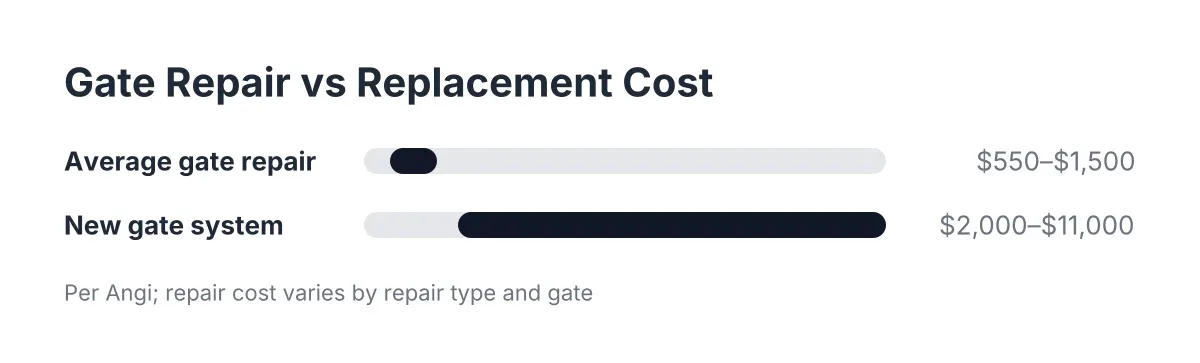
A clear decision rule helps here. According to Angi, automatic gate repairs average $900 and typically run $550 to $1,500 depending on the repair type and gate material. Angi also notes that when repair costs pass 50% of a new system's price, replacement becomes the better investment, with new systems running $2,000 to $11,000 or more.
Therefore, a sensor realignment, a battery swap, or a limit adjustment is an easy call: repair it. A failed motor on a fifteen-year-old operator with no available parts is a different conversation. Age matters too. If the manufacturer no longer supports your model, each repair buys less time than the last.
Timing affects cost as well. Angi reports that after-hours failures can add $150 to $200 in emergency service fees. If the manual release works and the property is secure, waiting for a regular appointment often saves money.
When Electric Gate Opener Troubleshooting Ends and a Service Call Begins
Stop the DIY work when the problem involves line voltage, a control board, a buried loop, or anything inside the motor housing beyond the battery. Gate operators combine electricity, moving steel, and stored spring or hydraulic force; a wrong move can injure you or damage parts that cost more than the service call. A technician with a meter and the right parts can usually diagnose in one visit what a homeowner might chase for a weekend.
Local knowledge counts here. Searching "gate repair near me" or "electric gate opener repair near me" will surface plenty of automatic gate companies, but in Chattanooga the right diagnosis often involves the ground, not the gearbox. Clay soil and freeze-thaw winters shift posts and footings, and a post that moved an inch can throw off a slide gate's track or bind a swing gate's arm. A company that works on both the gate and the opener can tell you whether you need a new motor, a reset hinge post, or both, before any work starts.
Quick Reference: Symptom to Likely Cause
- Gate does nothing, no sound: power supply, tripped breaker, or dead backup battery.
- Remote does nothing but keypad works: remote battery or remote programming.
- Gate starts to close, then reverses: dirty or misaligned photo eyes, or a damaged safety edge.
- Gate opens partway and stops: limit switch drift or an obstruction in the track.
- Humming without movement: stripped gear, seized arm, or failed capacitor.
- Gate moves slowly: weak battery, worn motor, or a gate that binds when moved by hand.
Run the checks in order, write down what you find, and you will either fix the gate yourself or hand a technician a head start. Either way, you skip paying someone to discover a dead remote battery, and you will know whether the quote you get for repair or replacement matches what the gate actually needs.
If you need automatic gate installation and repair, Chattanooga Fence Builders can help.
Prefer to talk it through? Call (423) 615-8548 — a quick call is usually the fastest way to get a straight answer for your situation.