Chattanooga Fence Setback Laws: Property Line Rules and Permits Explained
You just paid for a new wood fence, or you are about to. The last thing you want is a letter from the city or an angry neighbor telling you the fence sits where it should not. Chattanooga fence setback rules cover where a fence can go on your lot, how tall it can be, and when you need a permit before work starts. This guide walks through those rules in plain terms, so your fence stays where you put it and you can get on with the parts you actually care about, like when to stain it.
Here is the honest framing up front. Setback rules are not written to annoy homeowners. They exist to keep fences off utility easements, out of drivers' sightlines at corners, and off your neighbor's land. Get those three things right and most fence projects in Chattanooga go through without a hiccup.
What Fence Setback Laws in Chattanooga Actually Control
Setback rules answer one question: how far from a boundary does a structure need to sit? For fences, the boundaries that matter are your property lines, the street, and any recorded easements running through your lot.
In Chattanooga, residential fences are generally treated differently from buildings. A house might need to sit many feet back from the property line. Fences usually do not carry that same requirement, and in most residential zones you can place a fence at or near the property line itself. The catch is the word "near." The city's zoning ordinance, which was updated in recent years, sets different height limits for front yards versus side and rear yards, and corner lots carry extra restrictions for visibility.
Three layers of rules can apply to the same fence, and they do not always agree:
- City or county zoning. Chattanooga's zoning ordinance governs fence height and placement inside city limits. Outside the city, Hamilton County rules apply instead.
- Recorded easements. Utility, drainage, and access easements on your plat can limit where posts go, even on your own land.
- HOA covenants. Neighborhood rules often restrict height, material, and style beyond anything the city requires.
The strictest layer wins. A fence the city would approve can still violate your HOA covenants, and an HOA approval does not override a utility easement. Check all three before anyone digs a post hole.
How Far Does a Fence Have to Be From a Property Line in Tennessee?
Tennessee has no statewide law requiring a fence to sit a set distance from a residential property line. Placement rules come from local zoning, so the answer in Chattanooga depends on the city ordinance, your zone, and any easements or covenants on your specific lot. In most Chattanooga residential zones, a fence can sit on or just inside the property line.
That said, "can" and "should" are different questions. Building directly on the line means the fence becomes a shared boundary structure, and disputes over maintenance, repairs, or replacement get messier. Many homeowners set the fence a few inches to a foot inside their own line on purpose, following the setback rules that guide property placement. That keeps ownership clear, lets you maintain both sides without stepping onto the neighbor's land, and avoids arguments if a survey later shows the line is not where everyone assumed.
The bigger risk is not the setback itself. It is building on land you do not own. Lot lines in older Chattanooga neighborhoods rarely match the chain link fence the previous owner put up decades ago. If you build a new privacy fence on the old fence's footprint without checking, you may be inheriting someone else's mistake. A boundary survey costs money, but it costs far less than tearing out and resetting a fence line after a dispute.
Corner Lots and Sight Triangles
Corner lots carry the one setback rule that trips up the most homeowners. Where two streets meet, or where a driveway meets a street, drivers need to see oncoming traffic. Cities protect that view with a sight triangle, an area near the intersection where tall, solid structures are restricted.
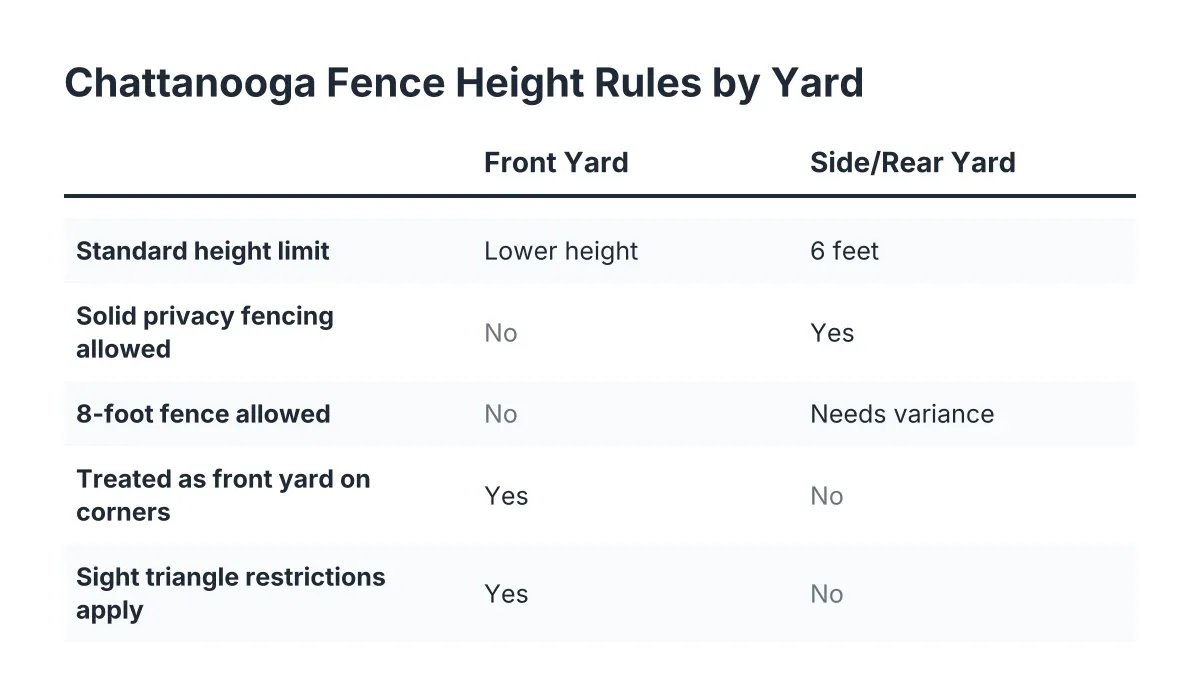
A six-foot solid privacy fence that would be fine along your back line can be a violation if it wraps around a street-facing corner and blocks the sight triangle. If your lot touches two streets, treat both frontages as front yards for planning purposes and confirm the sight triangle dimensions with the city before finalizing your fence layout. This is also worth checking before fence repair work on a corner lot; rebuilding a damaged section taller or more solid than the original can create a violation that the old fence never had.
Fence Setback Requirements by Yard: Front, Side, and Rear
Height, not distance, is where Chattanooga's rules bite hardest, and height limits change depending on which yard the fence sits in.
Front Yards
Front yards face the tightest limits. Chattanooga's zoning generally caps front yard fences at a lower height than side and rear fences, and solid privacy fencing in front of the house line is restricted in most residential zones. The intent is open streetscapes and clear sightlines. If you want privacy screening near the street, expect lower heights, more open designs, or landscaping instead of a solid wood fence.
Side and Rear Yards
Behind the front plane of the house, the rules loosen. Six-foot privacy fences are the standard in Chattanooga side and rear yards, and that height is permitted in most residential zones without special approval. This is where the typical wood fence or vinyl fence privacy project lives, and it is the least complicated part of the setback picture.
Is an 8 Foot Privacy Fence Too High?
An eight-foot privacy fence exceeds the standard residential height limit in most Chattanooga zones, where six feet is the common cap for side and rear yards. Going to eight feet usually requires a variance or special approval from the city, and HOAs often cap height at six feet regardless of what the city allows.
Suppose a homeowner in East Brainerd wants an eight-foot wood fence to block the view from a new two-story build next door. The city may not approve that height outright. Options in that scenario include applying for a variance, building to six feet and adding lattice if the ordinance allows it, or planting fast-growing screening behind a six-foot privacy fence. Each path has trade-offs in cost, approval time, and look, so it pays to confirm the rules before pricing the taller build.
Do I Need a Permit to Build a Fence in Tennessee?
Tennessee does not require a state-level permit for a residential fence; permitting happens at the city or county level. Inside Chattanooga city limits, fence projects are subject to the city's zoning standards, and depending on the project you may need a zoning review or permit before building. Outside the city, Hamilton County has its own process.
Here is the practical path for a Chattanooga homeowner in 2026:
- Confirm your jurisdiction. A Hixson or Middle Valley address may sit inside or outside city limits. Your rules depend on which side of that line you are on, not your mailing address.
- Pull your plat or survey. Look for recorded easements, especially utility and drainage easements along the rear and side lines where fences usually go.
- Check with the city's land development office. Ask what applies to your zone, your fence height, and your lot type. Corner lots and lots in overlay districts get extra scrutiny.
- Call 811 before digging. Utility locating is free, required before excavation, and non-negotiable. Fence posts go deep enough to hit buried lines.
- Get HOA approval in writing if you have one, before you schedule installation.
A reputable fence contractor will know the local requirements and can tell you early whether your project needs a review. However, the permit obligation legally sits with the property owner, so do not assume someone else handled it. Ask directly, and get the answer before the crew shows up.
What About Easements?
An easement is a recorded right for someone else, usually a utility, to use part of your land. You still own the ground, but the utility can access it. Fences built inside an easement can usually stay, but if the utility needs access, they can remove the fence and they are generally not obligated to put it back.
Therefore, think hard before running a new privacy fence down the middle of a drainage easement. If the easement is where the fence has to go, use a design that is easier to remove and reinstall in sections, and keep gates or removable panels where access is most likely.
What Happens If Your Fence Violates Setback or Height Rules
A fence that violates zoning does not fix itself with time. Common outcomes include a notice from the city after a neighbor complaint, an order to modify or remove the fence at your expense, and problems at resale when a buyer's survey flags the encroachment. Fences over a property line are the worst case; the neighbor can demand removal, and courts generally side with the deed, not the fence.
For example, say a homeowner in Signal Mountain replaces a sagging four-foot chain link fence with a six-foot wood privacy fence on the same posts' footprint, not realizing the old fence sat two feet onto the neighbor's lot. The old fence was tolerated for years. The new one triggers a survey, a dispute, and a tear-out. That is a hypothetical, but it maps to how these disputes actually start: a visible change draws attention to a boundary nobody had checked.
The lesson is simple. The time to verify the line is before installation, not after. An existing fence location proves nothing about where the property line runs.
Repairs, Replacements, and Grandfathered Fences
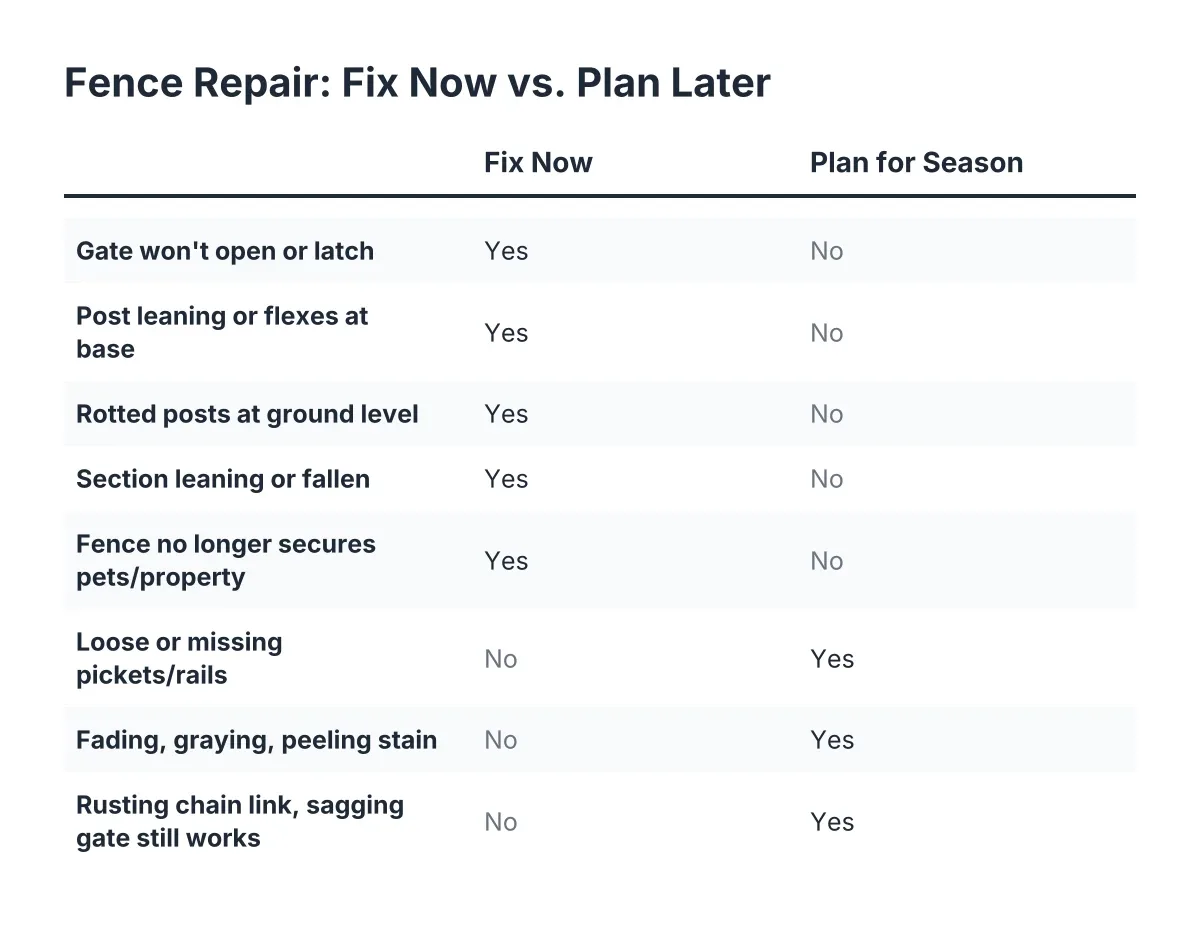
Setback rules matter for repairs too, not just new builds. If your existing fence predates the current ordinance and does not meet today's standards, it is likely a legal nonconforming structure, often called grandfathered. You can generally maintain and repair it. But a full fence replacement, or rebuilding a large portion, can trigger the requirement to bring the fence into compliance with current rules.
This creates a real decision point for homeowners weighing repair against replacement. Fixing a few leaning posts and swapping rotted pickets keeps the grandfathered status intact. Tearing out the whole run and rebuilding it may mean a shorter fence, a new location, or a permit you did not need before. If your fence sits closer to the street or taller than current rules allow, that is a strong argument for repairing what you have while it is still repairable.
Costs matter in this decision too. According to HomeAdvisor, fence installation runs between $6 and $50 per linear foot depending on material, averaging $23 per linear foot nationally. Angi puts the national average for a full fence install at $3,277, with typical projects ranging from about $1,860 to $4,843. Those are national figures, not Chattanooga quotes, but they show why keeping a compliant, repairable fence standing is often the cheaper path.
One honest caveat: zoning ordinances get amended, and the details in this guide describe how the rules generally work, not the current text of the code. For anything close to the line, literally or figuratively, confirm specifics with Chattanooga's land development office or Hamilton County before you build, and consider a boundary survey when the line itself is in doubt.
A Setback Checklist Before Your Fence Goes In
Pull this together before installation day and the setback question takes care of itself:
- Your plat or a recent survey, showing property lines and recorded easements
- Confirmation of jurisdiction, city of Chattanooga or Hamilton County
- Your zone's fence height limits for front, side, and rear yards
- Sight triangle requirements if you are on a corner lot or near a driveway intersection
- Written HOA approval, if applicable
- 811 utility locates, scheduled before any digging
- A conversation with your neighbor if the fence runs along a shared line
None of these steps is hard. Most take a phone call or a records search. Together they prevent the expensive version of this story, where the fence goes in fast and comes out slow.
What This Means for Your New Wood Fence
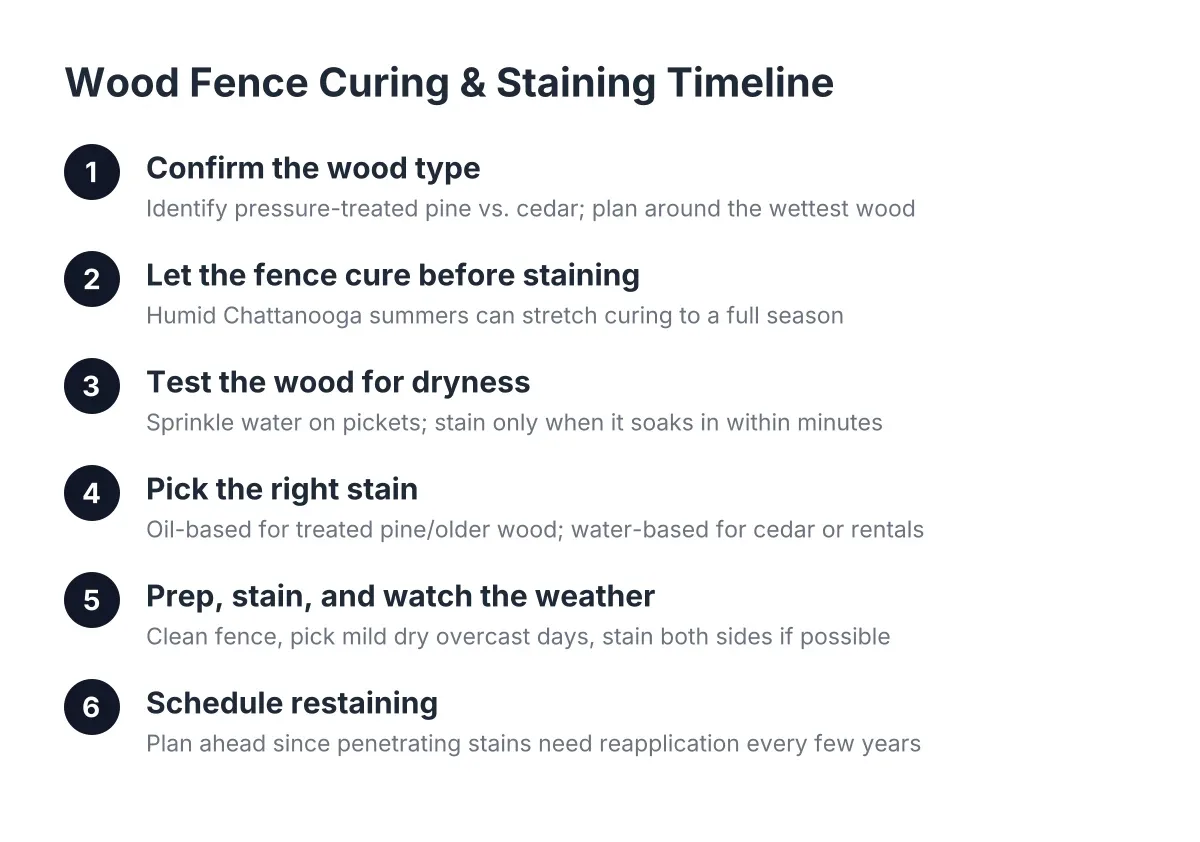
If your wood fence just went in, or is about to, setback compliance is the foundation under everything else you are planning for it. There is no point researching stain timing for a fence section that may have to move. Confirm the placement is solid first, keep your survey and any approvals in your records, and then shift your attention to the care side: letting pressure-treated wood dry out properly in Chattanooga's humidity before staining, and keeping posts solid through our clay soil's freeze-thaw cycles.
Chattanooga fence setback laws reward homeowners who check before they build. The rules are manageable, the exceptions are predictable, and almost every problem traces back to a line nobody verified or a corner lot nobody flagged. Handle those two things and your fence can stand on the same spot, legally and without argument, for as long as the posts hold.
If you need fence repair, Chattanooga Fence Builders can help.
Prefer to talk it through? Call (423) 615-8548 — a quick call is usually the fastest way to get a straight answer for your situation.