Wood Fence Replacement Cost vs. Repair: How to Make the Right Call
A leaning fence or a gate that drags on the ground forces a question nobody wants to answer blind: do you fix what's there, or start over? The honest answer depends on math, not guesswork. Wood fence replacement cost runs several times higher than most repairs, but a repair on a fence that's past saving is money thrown into the yard. This guide walks through how to tell the difference, what drives the numbers on each side, and the middle-ground options most homeowners and landlords never hear about.
If you own a rental in Chattanooga and a tenant just texted you a photo of a fence section lying flat in the grass, this decision matters even more. You're not just fixing a fence. You're deciding whether to spend a few hundred dollars now or commit to a project that could cost thousands across a property line.
Why This Decision Trips People Up
Most people only deal with a broken fence or gate a handful of times in their lives. So when it happens, there's no mental model to lean on. The fence looks mostly fine except for one bad stretch, and it's hard to know whether that bad stretch is a symptom or the whole problem.
Here's the pattern that catches people. A fence rarely fails all at once. One post rots at ground level and starts to lean. The lean puts strain on the neighboring posts. The gate hinges pull out of square, and suddenly the gate won't latch. By the time something visibly breaks, the damage has usually been spreading quietly for a year or more.
That's why the repair-versus-replace question can't be answered by looking at the broken part alone. You have to look at what the broken part is attached to. A new gate hung on a rotting post will sag again within a season. A new panel screwed to failing rails will pull loose in the next storm.
What Actually Fails on a Wood Fence
Wood fences in the Chattanooga area fail in predictable ways, and knowing the failure points helps you judge what you're looking at. Our clay-heavy soil holds water against posts, and freeze-thaw cycles in winter shift footings a little more each year. Humidity and seasonal rain speed up rot in any wood that touches the ground.
The usual suspects, roughly in order of how often they show up:
- Post rot at ground level. The post looks fine above grade but has gone soft right where it meets the soil. This is the number one killer of wood fences.
- Sagging or dragging gates. Usually a hinge problem, a post problem, or both. The gate itself is often fine.
- Broken or warped pickets. Cosmetic in small numbers, structural in large numbers.
- Failed rails. The horizontal boards that hold pickets crack or pull away from posts.
- Leaning sections. Almost always a footing or post issue, not a panel issue.
- Gray, dried-out wood. Not damage yet, but unsealed wood absorbs water and ages faster.
Notice that the most common failures are at the bottom of the fence, where you're least likely to look. The pickets you see from the kitchen window are usually the last thing to go.
When Repair Is the Right Financial Call
Fence repair makes sense when the damage is contained and the structure around it is sound. Replacing a few pickets, rehanging a gate, or resetting one or two posts costs a fraction of a new fence and can add years of life. For a rental property owner trying to pass a turnover inspection before re-listing, a targeted repair is often the fastest and cheapest path to a secure yard.
Repair is usually the right call when:
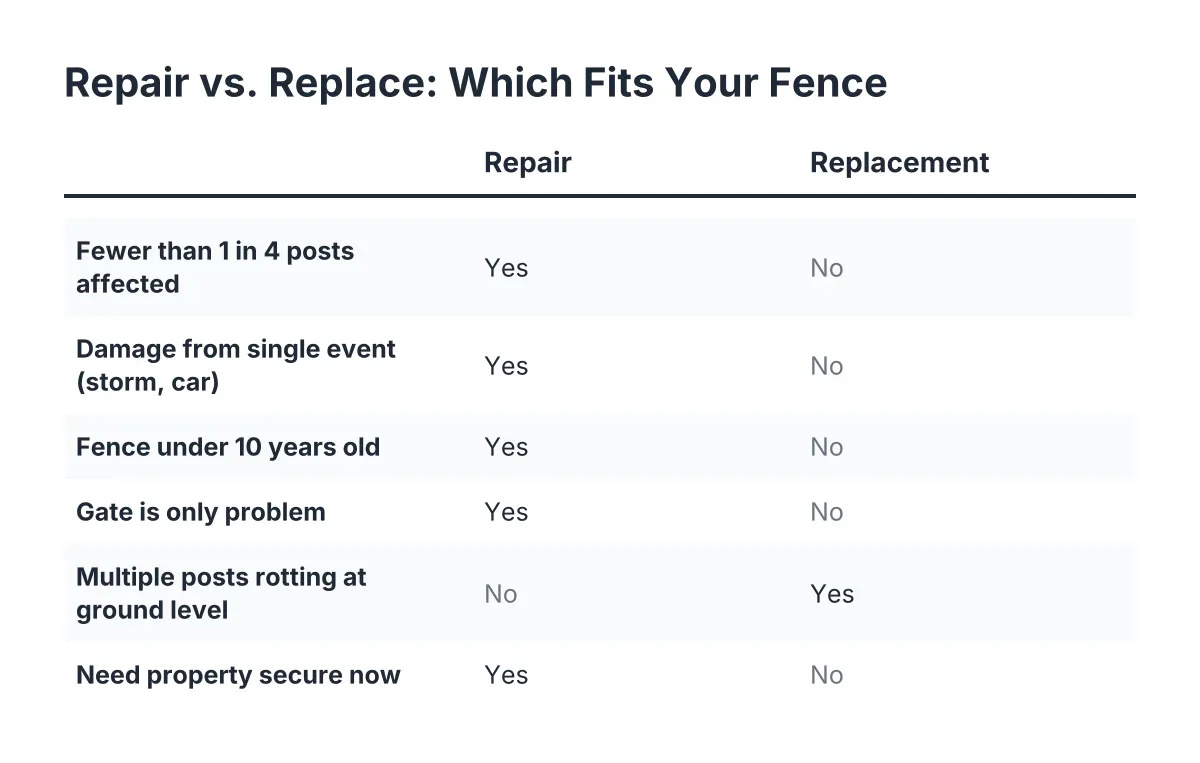
- Fewer than one in four posts have problems. If most posts are solid, the fence has a frame worth keeping.
- Damage comes from a single event. A storm took out two panels, or a car clipped a corner section. The rest of the fence wasn't failing; something hit it.
- The fence is under ten years old. Pressure-treated wood that's been maintained has plenty of life left at that age.
- The gate is the only problem. Gate repair, whether it's a manual latch or an automatic gate opener, is almost always cheaper than touching the fence itself.
- You need the property secure now. A repair buys time to plan and budget a replacement on your schedule instead of a tenant's.
That last point matters for landlords. Say a landlord in Hixson has a tenant moving in Friday, and the lease requires a fenced yard for a dog. One leaning section and a gate that won't latch do not require a new fence. A post reset and a hinge-and-latch repair get the yard secure in a day, and the full wood fence replacement cost conversation can wait until the budget allows.
A Note on Gates Specifically
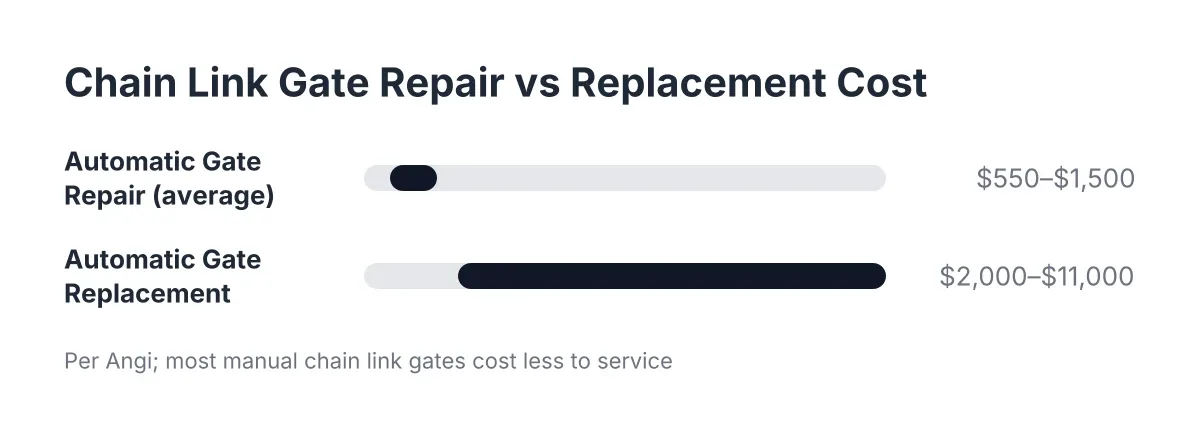
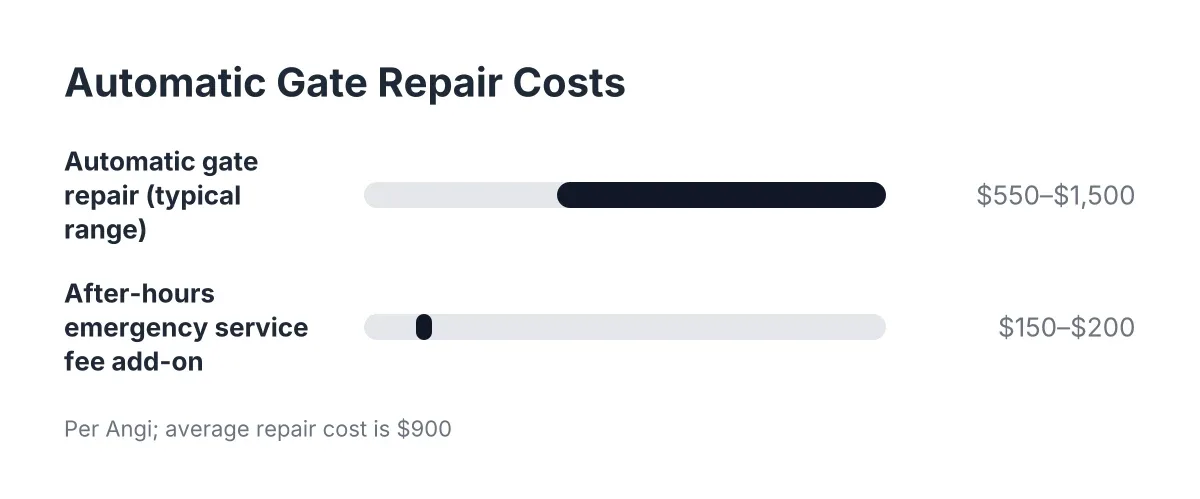
Gates fail more often than fences because they're the only part that moves. A gate that drags, won't latch, or swings crooked usually needs hinge work or a post fix, not a new gate. The same logic applies to automatic gates. According to Angi, automatic gate repairs average $900, typically ranging from $550 to $1,500 depending on the repair type and gate material. That's a meaningful number, but it's well below what a full new system costs.
Angi also offers a useful rule of thumb for powered gates: if the repair would cost more than half the price of a new system, replacement is the better investment, with new systems running $2,000 to $11,000 or more. That 50 percent threshold is worth remembering, because a version of it applies to fences too.
When Wood Fence Replacement Cost Is the Smarter Spend
Replacement makes financial sense when repairs would only chase failures around the fence line. If you fix two posts this spring, three more next fall, and a gate the following summer, you'll spend replacement money on repairs and still end up with an old fence. At some point, paying once beats paying often.
Replacement is usually the right call when:
- Multiple posts are rotting at ground level. Posts are the skeleton. When the skeleton goes, patching the skin doesn't help.
- The fence leans in more than one place. Widespread leaning means the footings or posts are failing as a system, not as individual parts.
- Rot has reached the rails and pickets, not just the posts. When you can push a screwdriver into boards in several spots, the wood itself is done.
- The fence is 15 to 20 years old or older. Even well-built wood fences have a natural lifespan, and Chattanooga's humidity doesn't extend it.
- Repair estimates keep stacking up. If the repairs you need this year approach half of what a new fence would cost, the gate rule applies: put the money toward the new structure.
For context on the replacement side of the ledger, Angi reports the national average cost to install a fence at $3,277, with a typical range of $1,860 to $4,843 depending on length and material. HomeAdvisor puts fence installation between $6 and $50 per linear foot depending on material, averaging $23 per linear foot nationally. Your actual number depends on your fence line, your material, and your site, which is why an on-site quote beats any online fence calculator. But those figures give you a realistic scale to weigh repair estimates against.
What Drives Wood Fence Replacement Costs Up or Down
The cost to replace a wood fence depends on more than length. The same 150 feet of fence line can land at wildly different prices based on what's being built and what's being torn out. The main drivers:
- Linear footage. More fence, more posts, more labor. This is why most pricing gets quoted per linear foot.
- Fence style. A standard flat privacy fence is the baseline. Board-on-board, shadow box, horizontal designs, and trim details genuinely use more lumber and more labor per foot, so they cost more for real reasons, not markup.
- Height. A taller privacy fence needs more material and often deeper-set posts, especially where wind load matters.
- Post material. Steel posts cost more upfront than wood posts but outlast them, which changes the long-term math.
- Tear-out and haul-off. Removing the old fence, including breaking out concrete footings, is real labor that shows up in the price.
- Site conditions. Slopes, tight access, tree roots, and Chattanooga's clay soil all affect how fast posts go in.
- Gates. Each gate adds hardware and labor, and a wood fence gate replacement costs more than the equivalent stretch of straight fence.
One more factor worth naming: the cheapest bid is often the most expensive fence. Pricing differences between contractors usually reflect construction practices and expected longevity, not just margin. A fence built fast with shallow footings and untreated contact points can need replacing years sooner than one built right, and then you're paying the wood fence replacement cost twice.
The Middle Path Most People Never Hear About
Repair versus replace isn't always a binary choice. There are hybrid approaches that stretch a budget, and they matter most for landlords managing several properties where every dollar competes with the next unit's needs.
The best example involves rotting posts. The instinct when a wood post rots is to dig out the whole post and its concrete footing and start fresh. However, that's not always the practical move. In many cases, the rotted post can be cut off above the deteriorated section and a new steel post set into the original concrete footing. You skip the demolition, keep the footing, and end up with a post that outlasts the wood it replaced.
That approach also works as a bridge strategy. Interim post repairs that preserve the footings keep the fence standing and secure now, and the structural work carries forward when you eventually do a full replacement with steel posts. You're not throwing repair money away; you're paying for part of the future fence early.
Staining is the other underused lever. Sealing or staining both sides of a wood fence does more than improve the look. It meaningfully extends the fence's lifespan and improves the return on the original investment. For a rental property, a stained fence at year five can push the replacement decision out several years, which is the cheapest fence decision you'll ever make.
Running the Numbers: An Illustrative Scenario
Suppose a landlord owns a duplex in East Ridge with about 120 feet of ten-year-old wood privacy fence. The tenant reports that the gate won't close and one section leans into the neighbor's yard. An inspection finds two rotted posts, a gate pulling off its hinges, and otherwise solid rails and pickets.
In that scenario, the repair path might run a few hundred dollars: reset or sleeve the two posts, rehang the gate on the repaired post, and replace a handful of pickets. The replacement path, using the national per-foot averages above as a rough yardstick, would likely land in the low thousands. With roughly three quarters of the fence still sound, repair wins clearly, and steel post sleeves mean the fix isn't wasted money if replacement comes at year fifteen.
Now change one variable. Suppose the inspection finds six rotted posts out of twelve, soft rails on the back run, and a previous repair already failing. The repair bill climbs toward half the replacement price, and every unrepaired post is a future service call. In that version, the wood fence replacement cost is the smarter number to write down, even though it's the bigger one.
The lesson from both versions: the decision isn't about the size of the visible damage. It's about the ratio of repair cost to replacement cost, and the condition of everything you're not replacing.
Questions Worth Asking Before You Decide
A few practical questions sharpen the decision, whether you're doing the assessment yourself or getting a quote.
How Do I Know If My Fence Needs Repair or Replacement?
Check the posts first, not the pickets. Grab each post near a damaged section and push; a solid post barely moves, while a failing one rocks at the base. Probe the wood at ground level with a screwdriver. If more than a quarter of your posts are soft or loose, you're in replacement territory. If the damage traces back to one or two posts or a single event, repair is likely the better spend.
Do I Need a Permit to Build a Fence in Tennessee?
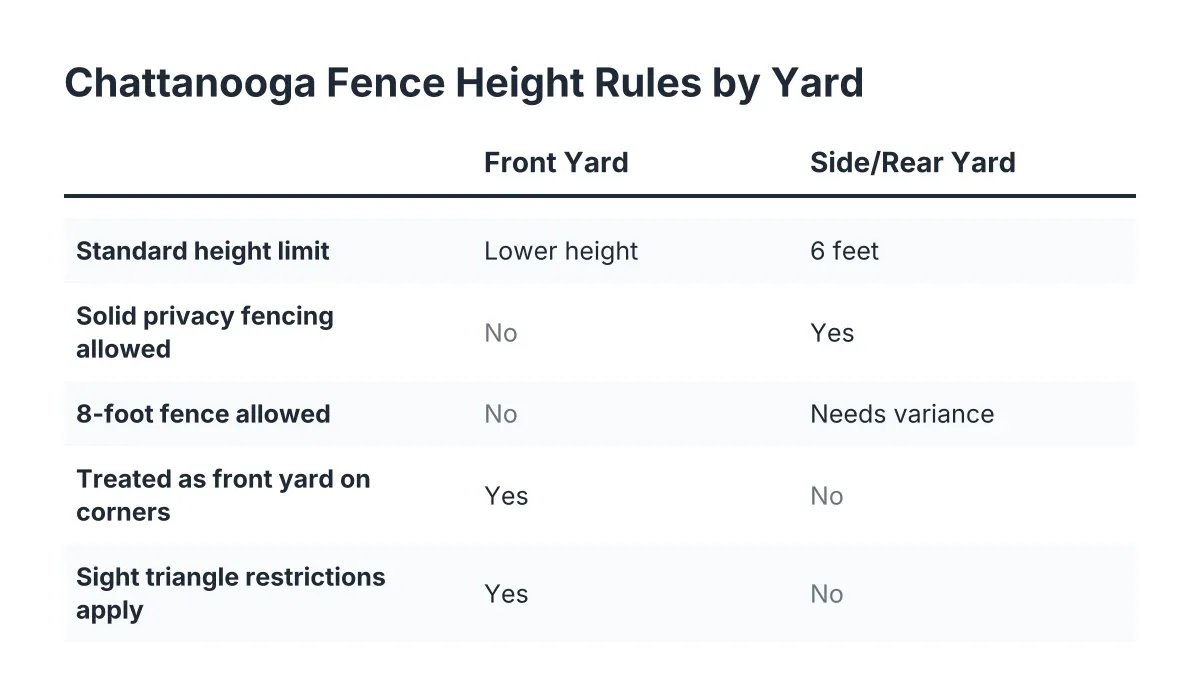
Permit requirements for fences in Tennessee vary by city and county rather than following one statewide rule. In the Chattanooga area, requirements can depend on fence height, location on the lot, and whether the property sits in a zone with specific restrictions. Setback rules from the property line also vary locally. Before a full replacement, check with your local codes office or ask your contractor, since fence contractors deal with these rules on every job.
Can I Repair My Fence Myself or Should I Hire a Professional?
Picket swaps, board replacement, and basic latch fixes are reasonable DIY jobs for anyone comfortable with a drill and a saw. Post work is a different animal. Setting a post plumb in Chattanooga clay, getting the footing depth right, and rehanging a gate square to a new post are where DIY repairs most often fail. Automatic gate openers add electrical components that are best left to someone who works on them regularly; a misdiagnosed opener can mean paying twice.
The Bottom Line for Your Wallet
The repair-or-replace decision comes down to three checks you can run in an afternoon. First, count the failing posts; under a quarter failing favors repair, over that favors replacement. Second, compare the repair estimate to a realistic replacement quote; once repairs approach half the cost of new, replacement wins. Third, be honest about the fence's age, because repairs on a twenty-year-old fence buy months, not years.
For small landlords, add one more layer: think per property, not per fence. A durable repair with steel post sleeves on a mid-life fence protects cash flow. A full replacement on a fence that's nickel-and-diming you every season protects your time, which across ten units is worth more than the fence.
Either way, get the structure assessed before anyone quotes you a number. The visible damage is rarely the whole story in this climate, and the right answer, repair or replace, starts with knowing what's actually holding your fence up.
If you need fence repair, Chattanooga Fence Builders can help.
Prefer to talk it through? Call (423) 615-8548 — a quick call is usually the fastest way to get a straight answer for your situation.