Wrought Iron Fence Durability in Chattanooga’s Humid Climate: An Honest Guide
Wrought iron fence durability gets talked about like it is a fixed number. It is not. The same fence that lasts generations in a dry climate can show rust streaks within a few years in Chattanooga if nobody watches it. Our humidity, our seasonal rain, and our clay-heavy soil all pull on an iron fence in ways that most national articles never mention. This guide walks through how iron actually holds up here, what makes it fail, and how to decide whether it earns its keep on your property or your rentals.
Why Iron Has a Reputation for Lasting Forever
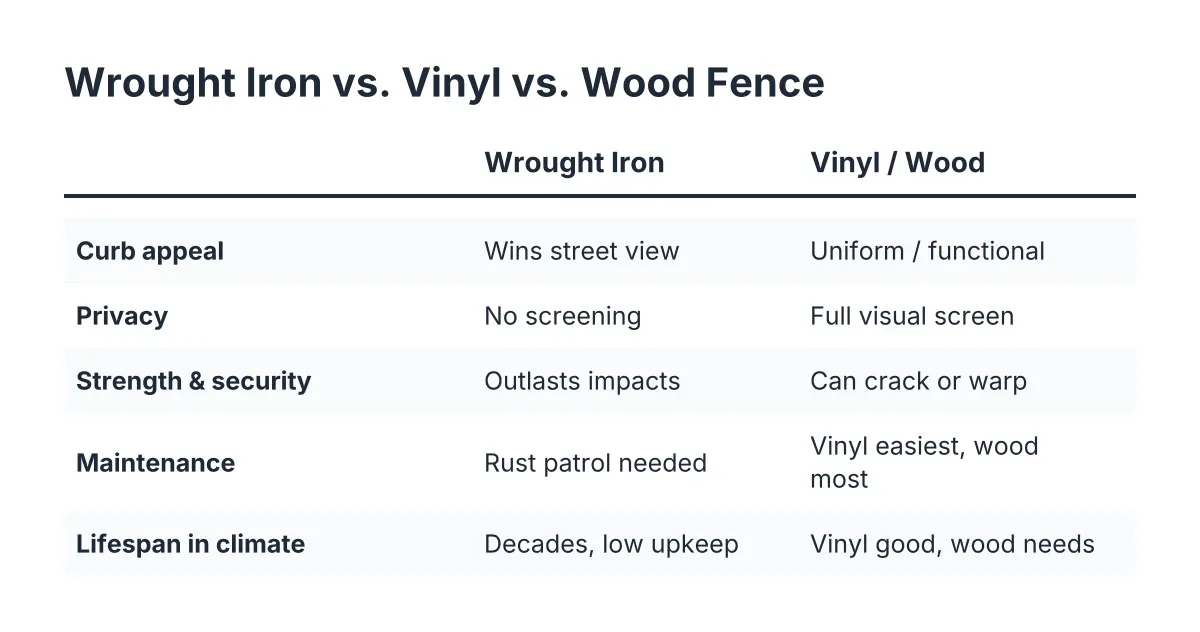
Walk through any older Chattanooga neighborhood and you will see iron fences that have stood for a long time. That reputation is earned. Iron is dense, heavy, and strong in a way that wood, vinyl, and chain link cannot match. A car can bump an iron fence and the fence often wins. A falling branch that would snap wood pickets might only scratch iron.
Compare that to wood. Wood fence posts warp, twist, and rot over time, and even well-painted panels often outlive the posts holding them up. Vinyl resists rot and fading, but it is still plastic; it can crack under hard impact and it will burn in extreme conditions. Chain link is tough and cheap, but nobody calls it handsome.
Iron sits in a different category. It does not rot. It does not warp. Termites ignore it. UV light that fades vinyl and grays out wood does nothing to metal. So when people ask how long do wrought iron fences last, the honest answer is that the metal itself can outlast the house, if one condition is met.
That condition is the whole story: the coating has to stay intact. Iron's only real enemy is rust, and rust needs moisture. Chattanooga has plenty of it.
What Chattanooga's Climate Does to Wrought Iron Fence Durability
Chattanooga's humidity, rain, and freeze-thaw winters are the three forces that decide how long an iron fence lasts here. Humidity keeps moisture on the metal for hours after rain stops. Rain finds every chip in the paint. Freeze-thaw cycles shift posts and crack footings, opening new paths for water. Manage those three things and iron lasts for decades.
Here is how each one works against the fence.
Humidity keeps the metal wet
Rust is a chemical reaction between iron, oxygen, and water. In a dry climate, a morning rain evaporates fast and the metal spends most of its life dry. In the Tennessee Valley, humidity hangs around. Dew forms on the rails most mornings from spring through fall. Any spot where the protective coating has chipped stays damp long enough for rust to start and keep going.
The rust itself then makes things worse. Rust is porous, so it holds moisture against the fresh metal underneath. A rust spot the size of a dime, left alone through a few humid Chattanooga summers, becomes a flaking patch. That is why wrought iron fence maintenance here is less about effort and more about catching problems early.
Rain tests every joint and weld
Seasonal rain does not just wet the surface. Water collects at every joint, weld, and decorative scroll where two pieces of metal meet. Those junctions are where coatings are thinnest and where water drains slowest. The decorative details that make an iron fence beautiful, finials, scrollwork, twisted pickets, are also the hardest spots to coat evenly and the first spots to show orange.
The bottom rail takes the worst of it. Splash-back from the ground, grass clippings piled against the metal, and mulch holding moisture against the rail all speed up corrosion low on the fence. Most iron fences fail from the bottom up, not the top down.
Clay soil and freeze-thaw move the posts
Chattanooga's clay-heavy soil swells when wet and shrinks when dry. Add our freeze-thaw winters and the ground around a fence post moves more than most homeowners expect. When a post shifts, several things happen at once. Gates go out of alignment and start dragging. Welded connections take stress they were not designed for. Hairline cracks open in the concrete footing, and water follows those cracks straight down to the buried portion of the post.
That buried section is the most vulnerable part of the whole fence. You cannot see it, you cannot repaint it, and it sits in wet clay for months at a time. Proper footing depth and drainage at installation matter more for wrought iron fence durability in this region than any maintenance you do afterward. A fence set in shallow, poorly drained footings will fail at ground level no matter how faithfully someone paints the visible parts.
How Long an Iron Fence Actually Lasts Here
A properly installed and maintained iron fence in the Chattanooga area can serve for several decades, often outlasting two or three wood fences on the same line. A neglected one can look rough within five to ten years and develop structural rust-through at the base within a couple of decades. The spread between those outcomes is wider than for any other fence material.
Three factors control which outcome you get:
- Coating quality at installation. Modern fences arrive with factory powder coating or galvanizing under paint. Older true wrought iron relied on paint alone. The factory finish is the fence's first and best defense, and field cuts or welds that break that finish need proper touch-up before the crew leaves.
- Footing and drainage. Posts set deep enough for our frost conditions, in footings that shed water instead of cupping it, protect the part of the fence nobody can maintain later.
- Inspection habit. Not labor, just attention. One slow walk along the fence line each spring, looking for chips, bubbling paint, and orange streaks, catches problems while they are a ten-minute fix.
Notice what is not on that list: constant repainting. A quality iron fence in good shape does not need yearly paint. It needs spot treatment where the coating fails, and a full recoat on a cycle measured in many years, not seasons.
The Maintenance Reality, Separated From the Myth
The myth says iron fences demand endless upkeep. The reality in Chattanooga is a short seasonal routine that takes less time than staining one side of a wood privacy fence. Here is what actually keeps an iron fence sound in this climate:
- Walk the line each spring. Look closely at the bottom rail, the post bases, every weld, and anywhere metal meets concrete. These are the failure points.
- Treat chips immediately. Sand the spot to bare metal, apply a rust-inhibiting primer, and touch up with matching paint. A dime-sized chip is a ten-minute job. A neglected one becomes a section replacement.
- Keep vegetation off the metal. Vines, tall grass, and shrubs pressed against iron trap moisture and hide rust until it is advanced. Leave a gap between plantings and the fence.
- Rinse after heavy pollen season. Pollen, dirt, and organic debris hold moisture on the surface. A garden hose is enough; no pressure washer needed, and a pressure washer can actually chip the coating.
- Check gate hardware twice a year. Hinges and latches carry moving loads, so their coatings wear first. A little lubricant and a visual check prevent the most common service calls.
That is the whole program. However, honesty requires one caveat: if your fence is true heritage wrought iron rather than modern coated steel, or if rust has already eaten into a structural member, that is professional territory. Grinding out deep corrosion, re-welding a rail, or resetting a heaved post calls for someone who does fence repair for a living, and a fence that has gone too far may cost more to restore than a fence replacement would.
The Gate Is Where Iron Fences Fail First
If an iron fence has a weak point in this climate, it is the gate. The fence panels just stand there. The gate moves hundreds of times a month, hangs its full weight on two or three hinges, and depends on posts that stay exactly where they were set. In clay soil that swells and shrinks through the seasons, "exactly where they were set" is a lot to ask.
Suppose a landlord with a duplex in East Ridge gets a call during tenant turnover: the iron walk gate is dragging on the concrete and will not latch, and the lease requires a secure yard for the tenant's dog. Nine times out of ten in that scenario, the fence itself is fine. The gate post has tilted a degree or two from soil movement, or a hinge has worn and dropped the gate. That is a gate repair, an adjustment or hardware swap, not a sign the fence is dying. Knowing the difference saves owners from paying for replacements they do not need.
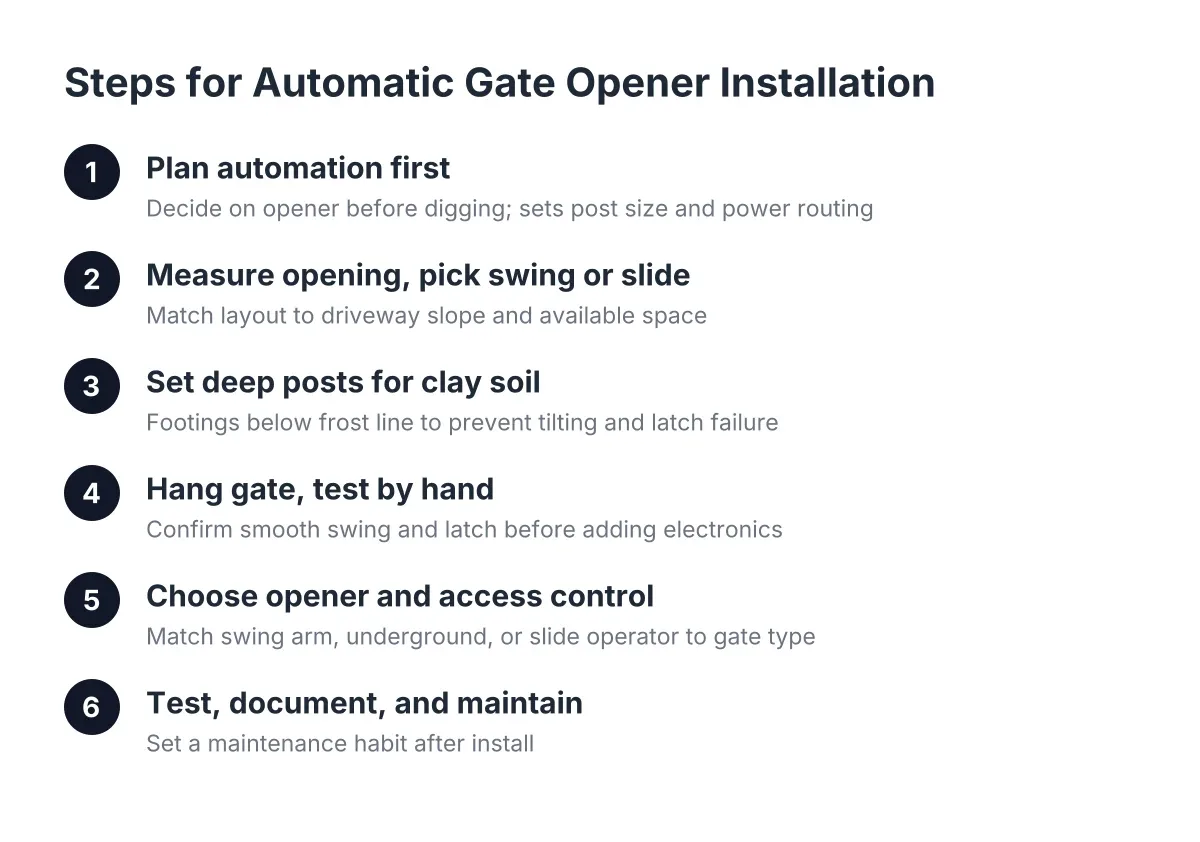
Automatic gates add another layer. An iron driveway gate is heavy, and its weight is exactly why the opener, the hinges, and the post alignment all have to work together. When an automatic gate stops responding or the opener just clicks, the cause is often electrical or mechanical rather than the iron itself. According to Angi, automatic gate repairs average $900, typically ranging from $550 to $1,500 depending on repair type and gate material. That is a wide range, but it is still a fraction of replacing a custom iron gate.
For a small landlord, the takeaway is practical: budget for gate hardware and alignment service over the life of the property, and treat the iron panels themselves as a long-term asset that mostly needs watching.
Is Iron Worth It for a Rental Property?
For a rental, iron makes sense in specific situations and not in others. The durability case is strong; tenants cannot easily damage it, it survives storm debris that flattens wood, and it never needs staining between tenants. The cost case is more complicated.
Iron sits at the top of the fencing price range. For context, HomeAdvisor puts fence installation between $6 and $50 per linear foot depending on material, averaging $23 per linear foot nationally, and iron lives at the high end of that spread. For a landlord running numbers across several units, that premium has to earn its keep. Many property owners find the average cost of a wrought iron fence hard to justify for a back yard that just needs to contain a dog, and a chain link fence or vinyl fence handles that job for less.
Where iron earns its premium on rentals:
- Street-facing frontage where curb appeal directly affects rent and listing photos
- Properties you plan to hold long term, where one iron fence outlasting multiple wood fences changes the total-cost math
- Decorative wrought iron fence panels on a short front run, paired with cheaper fencing on the sides and back, which buys the curb appeal without the full-perimeter price
- High-abuse locations where wood gets kicked in and vinyl gets cracked
Where it does not: full-perimeter enclosure on a budget rental, or any property you plan to sell soon, where you will not hold it long enough to collect the longevity payoff. Is a wrought iron fence expensive compared to alternatives? Up front, yes. Over thirty years on a property you keep, the math often flips.
One more note on terminology. Most "wrought iron" sold today is actually welded steel with a powder-coat finish; true hand-forged wrought iron is mostly a restoration specialty now. The modern steel version holds up better against Chattanooga humidity than old paint-only iron, because the factory coating is more uniform than any brush job. If you are pricing a new wrought iron fence in 2026, modern coated steel is almost certainly what you are comparing.
What to Ask Before You Commit to Iron in This Climate
The install decides most of the lifespan, so the questions you ask before the first post goes in matter more than anything you do after. Any installer working in Chattanooga should have clear answers to these:
- How deep will the posts be set, and how does that account for frost and our clay soil?
- How will the footings shed water instead of holding it against the post?
- What is the coating on the panels, and how will field cuts and welds be sealed on site?
- How is the bottom rail protected from ground splash and trapped debris?
- For a gate, how are the gate posts sized and footed differently from line posts?
A contractor who answers those in plain terms, before any work starts, is telling you they understand why iron fences fail here. A contractor who waves them off is telling you something too.
The Bottom Line on Iron in the Tennessee Valley
Wrought iron fence durability in Chattanooga comes down to a simple trade. The metal gives you strength no other residential fence material can match, and in exchange it asks for two things: a correct installation that respects our soil and drainage, and a few minutes of attention each spring. Meet those terms and the fence becomes the last one that property line ever needs. Ignore them and humidity will collect its toll, one chipped spot at a time, starting at the bottom rail and the gate hinges.
For homeowners, that trade usually favors iron anywhere appearance matters. For small landlords, it favors iron on frontage and long-hold properties, and favors cheaper materials everywhere else. Either way, the fence will tell you what it needs if you walk the line once a year and listen.
If you need fence installation, Chattanooga Fence Builders can help.
Prefer to talk it through? Call (423) 615-8548 — a quick call is usually the fastest way to get a straight answer for your situation.