Leaning or Shifting Fence Posts: Causes, Risks, and How to Fix Them
A fence that leaned a little last fall and leans more this spring is not settling in. It is failing in slow motion. Leaning or shifting fence posts are the most common fence problem we see around Chattanooga, and the cause is usually underground, not in the boards you can see. This guide walks through why posts move, what happens if you ignore it, and how to fix leaning fence posts step by step, whether you do it yourself or hire it out.
The good news: a leaning post caught early is often a repair, not a replacement. The bad news: wait too long and the lean spreads down the line, pulling rails loose and cracking footings until the only honest answer is new fence.
Why Fence Posts Lean and Shift in the First Place
Fence posts lean or shift for four main reasons: rot at the ground line, undersized concrete footings, soil movement, and physical force like wind or a sagging gate. In Chattanooga, clay-heavy soil and freeze-thaw winters make the soil-movement problem worse than in most regions, because wet clay swells, dry clay shrinks, and frost pushes footings upward.
Here is how each cause shows up:
- Rot at the ground line. Wood posts fail where the post meets the soil, not at the bottom. The post may look fine above grade and be mush an inch below it.
- A footing that is too small. A post needs a generous collar of concrete on all sides. A skinny footing cracks under lateral force, and the break becomes a permanent wobble point.
- Soil movement. Clay expands when wet and contracts when dry. Add freeze-thaw cycles and the footing gets levered a little more each season.
- Load and force. A gate hung on a line post, kids climbing the fence, or one strong storm can start a lean that the soil then makes worse.
Knowing the cause matters because the fix is different for each one. Straightening a rotted post is wasted effort. Replacing a solid post that just has a cracked footing is wasted money.
What Happens If You Ignore a Leaning Fence
Ignoring a leaning fence turns one cheap repair into several expensive ones. A single tilted post transfers its load to the rails, which pull on the next posts, which start to lean too. For a landlord, it also becomes a liability and leasing problem: a fence that cannot contain a tenant's dog is a fence that does not do its one job.
Suppose you own a rental in Hixson and the turnover inspection shows two posts leaning along the back line. In that scenario, fixing those two posts now is a small line item. Let them go a year, and the illustrative math changes: more posts involved, rails warped out of their routing, and a conversation about fence replacement instead of fence repair. Catching movement early is the single biggest cost lever you control.
Now for the fix. The steps below cover a wood fence post set in concrete, the most common setup in this area. Chain link and vinyl follow the same logic with different hardware.
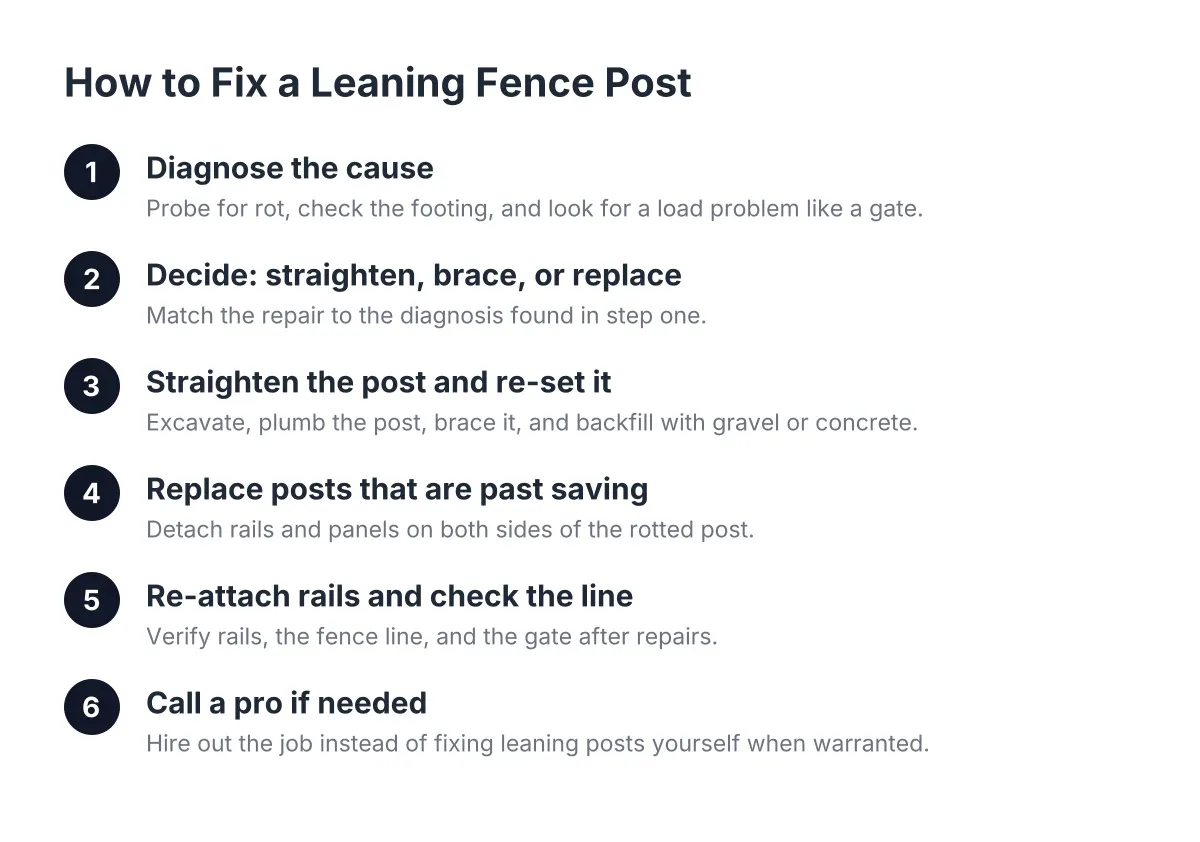
How to Fix a Leaning Fence Post
Before touching a shovel, diagnose. Grab the leaning post at chest height and rock it. Then check three things:
- Probe at the ground line. Push a screwdriver into the post right where it meets the soil. If it sinks in easily, the post is rotted and must be replaced or cut and sleeved, not straightened.
- Check the footing. Dig a few inches around the base. A cracked or crumbled footing means the concrete failed. A solid footing moving as one unit means the soil let go of it.
- Look for a load problem. If the leaning post carries a gate, the gate is likely the cause, and gate repair or a dedicated gate post is part of the fix.
Write down what you find for each post. On a longer run, you will usually find a mix: one rotted post, two with cracked footings, one that just needs the soil recompacted. Each gets a different treatment in the steps that follow.
Step 2: Decide Between Straightening, Bracing, and Replacing
Match the repair to the diagnosis. A solid post in moved soil can be straightened and re-set. A solid post on a cracked footing needs the footing rebuilt. Additionally, a rotted post needs more than straightening, but it may not need full removal.
Here is a decision rule worth knowing. When a wood post rots at ground level but the concrete footing is sound, you can cut the post off above the rot and set a steel post into the original footing. Homeowners often assume the whole footing has to come out. It does not, and skipping that demolition saves real labor. One caution: posts concreted in within the past year grip hard and fight removal, while older footings often pop out with less effort. That changes which approach costs less on your specific fence.
This is also where repair-versus-replace gets decided. If more than a third of the posts on a run are failing, or the panels themselves are rotted, put the money toward fence replacement instead. An interim post repair that preserves good footings still has value, since it keeps the fence standing and effectively applies that cost toward a future rebuild with steel posts.
Step 3: Straighten the Post and Re-Set It
For a solid post that shifted in the soil, excavate beside the footing on the side opposite the lean. Dig down along the concrete until the post can move. Push the post plumb, check it with a level on two adjacent faces, and brace it with two diagonal 2x4s staked into the ground.
Next, backfill. For minor movement in stable soil, compacted gravel and soil tamped in firm layers can hold. For Chattanooga clay, pour new concrete into the excavated gap so the footing regains a full collar on all sides. Slope the top of the concrete away from the post so water sheds instead of pooling at the wood.
Leave the braces on until the concrete cures. Pulling them early is the most common reason a straightened post ends up leaning again within a month.
Step 4: Replace Posts That Are Past Saving
For rotted posts, detach the rails and panels on both sides, then remove the post. If the footing is sound, use the cut-and-sleeve approach from Step 2 with a steel post. If the footing is cracked, dig the whole thing out and start clean.
Dig the new hole deep enough that the footing sits below the frost line, and wide enough for a thick ring of concrete around the post. Skimping here is how the problem comes back in two winters. Set the post, plumb it, brace it, pour, and crown the concrete away from the post.
On sloped ground, two details matter. Backfill one side slightly higher so the top rail runs level across the grade change. On steep sections, shorten the post spacing, because full-length rails will not reach the post routing when the line angles up or down.
Step 5: Re-Attach Rails, Check the Line, and Verify the Gate
Reattach rails and panels, replacing any fasteners that pulled loose or rusted. Before the final screws go in, sight down the fence line or stretch a string between the end posts, the same way installers do before digging, and confirm the run is straight.
If a gate hangs anywhere on the repaired run, open and close it a dozen times. A gate that drags or will not latch means a post is still out of plumb, or the gate needs its own repair. For an automatic gate, misaligned posts strain the operator, so verify alignment before running the motor.
When to Call a Pro Instead of Fixing Leaning Posts Yourself
Call a professional when the leaning fence post problem involves more than two or three posts, a gate post, rock or roots in the dig, or a fence on a property line. DIY makes sense for one solid post that shifted in soft soil. Beyond that, the labor and the stakes climb fast.
A few honest trade-offs to weigh:
- Scale. One post is a Saturday. Six posts with concrete demolition is a different kind of weekend, and rental turnovers rarely wait for it.
- Budget reality. For context, Angi puts the average cost of installing a fence nationally at $3,277, which is why a targeted post repair is usually the budget-friendly move when the rest of the fence is sound. Online fence cost calculator tools can give a rough replacement number to compare against a repair quote.
- Boundary and permit questions. If the fence sits on or near a property line, confirm local rules before re-setting posts. Chattanooga and the surrounding Tennessee and Georgia communities handle setbacks and permits differently, and a contractor who works here deals with those rules weekly.
- Spreading the cost. If the diagnosis turns into fence replacement and cash is tight, ask contractors directly about payment options when you request a quote. Many shoppers never ask, then default to a high-interest card.
The core message is simple. Leaning and shifting posts almost always announce themselves early, and the underground cause determines the right fix. Diagnose first, repair what is sound, replace what is rotted, and give every post the concrete it should have had the first time.
If you need fence repair, Chattanooga Fence Builders can help.
Prefer to talk it through? Call (423) 615-8548 — a quick call is usually the fastest way to get a straight answer for your situation.