How Wrought Iron Fences Perform in Chattanooga Freeze-Thaw Winters
If you just put money into a fence, you have probably started noticing how weather treats it. Chattanooga winters are hard on fences in a specific way: the ground freezes, thaws, and freezes again, and our clay-heavy soil moves with every cycle. So it is fair to ask about freeze-thaw fence performance and how wrought iron fences perform in those conditions before you commit to one, especially if you have already watched a wood fence post heave or lean after a wet winter. The short answer is that iron handles the cold better than almost any other fence material, but the ground under it does not care what the fence is made of. This guide walks through what freeze-thaw actually does to a fence, where iron holds up, where it fails, and what a good installation does differently here.
What Freeze-Thaw Weather Actually Does to a Fence
Most fence damage in a Chattanooga winter does not come from the cold itself. It comes from water. Rain soaks into the soil, the temperature drops below freezing overnight, and the water in the ground expands as it turns to ice. Then the afternoon warms up, the ice melts, and the soil settles back down, a little differently than before.
Repeat that cycle a few dozen times between December and February and the ground around your fence posts is pushing, pulling, and shifting the whole time. Clay soil makes it worse. Clay holds water instead of draining it, so there is more moisture in the ground to freeze. That is why a fence post set in Chattanooga clay faces more movement than the same post set in sandy, fast-draining soil.
The damage shows up in a few predictable ways:
- Frost heave. Ice forming under or beside a shallow footing pushes the post upward. The post may settle back, or it may stay high and leave the fence line wavy.
- Leaning posts. Soil that expands on one side of a footing and not the other tilts the post over time.
- Sagging gates. A gate post that moves even a small amount throws the latch out of alignment. This is the most common winter complaint we hear about gate repair.
- Material stress. Wood pickets and rails swell when wet and shrink when dry. Over enough cycles, that movement loosens fasteners, opens cracks, and warps boards.
Every fence in this region deals with the first three. The fourth one is where material choice starts to matter.
How Wrought Iron Fences Respond to Freeze-Thaw Cycles
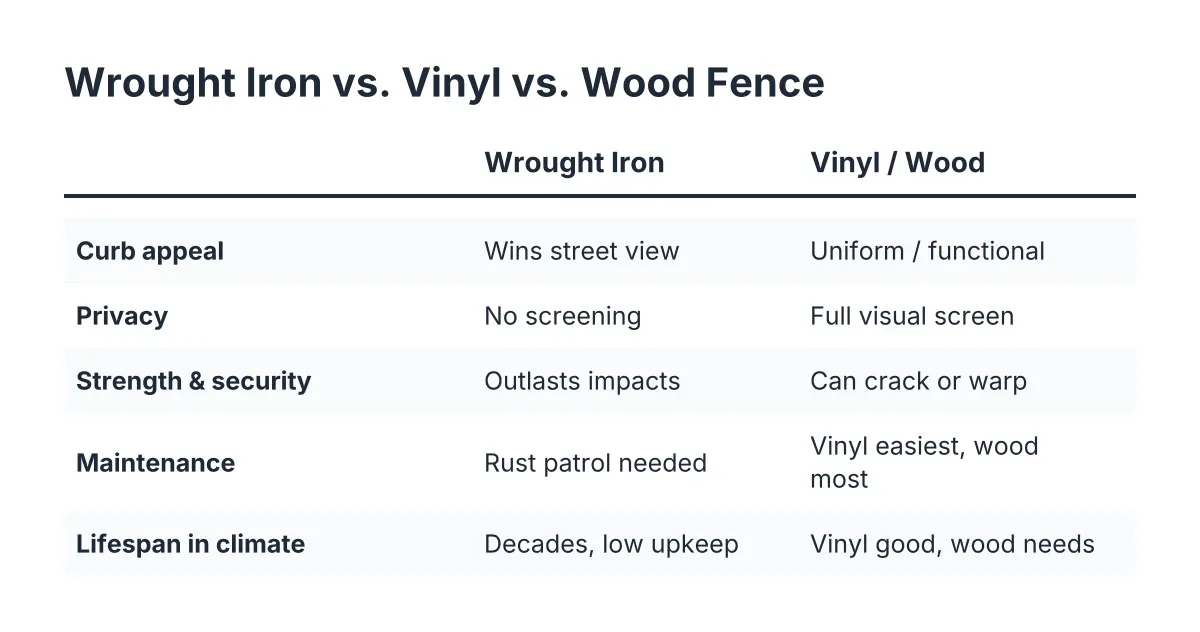
Wrought iron fences perform better in freeze-thaw winters than wood, vinyl, or chain link in one specific way: the material itself does not change when the temperature swings. Iron does not absorb water, so it does not swell, shrink, crack, or warp through a winter of wet-freeze-dry cycles. The weak point for iron in a Chattanooga winter is not the fence; it is the footing and the finish.
Think about what happens to each material through a January week here. It rains Monday, freezes Tuesday night, hits the fifties Thursday, and freezes again Friday.
A wood fence soaks up Monday's rain. The water inside the boards freezes Tuesday and expands, stressing the grain from the inside. Thursday it dries partway, and Friday it freezes again. Wood posts take the worst of it because they sit in the wettest part of the system, right at ground level, which is why wood posts commonly rot and fail even when the panels above them have been repainted and maintained for years.
Vinyl does not absorb water, but it gets brittle in the cold. A hard impact against a vinyl fence on a freezing morning, say a branch coming down or a trash can blown into it, can crack a panel that would have flexed in July.
Iron ignores all of that. The pickets and rails come out of winter exactly as they went in, as long as two things were done right: the posts were set below the frost line in proper footings, and the finish on the metal is intact. The way freeze, thaw, and freeze cycles affect a fence depends entirely on whether those two conditions are met; they carry almost all of the weight in how a wrought iron fence performs over its first ten winters, so they deserve their own sections.
The Footing Is the Fence: Why Posts Decide Everything
Here is the part most fence marketing skips. The panels are not what fails in a freeze-thaw climate. The posts are. A fence is only as straight as the footings holding it, and frost heave attacks footings regardless of what is bolted on top of them.
For an iron fence in Chattanooga clay, that means a few non-negotiables:
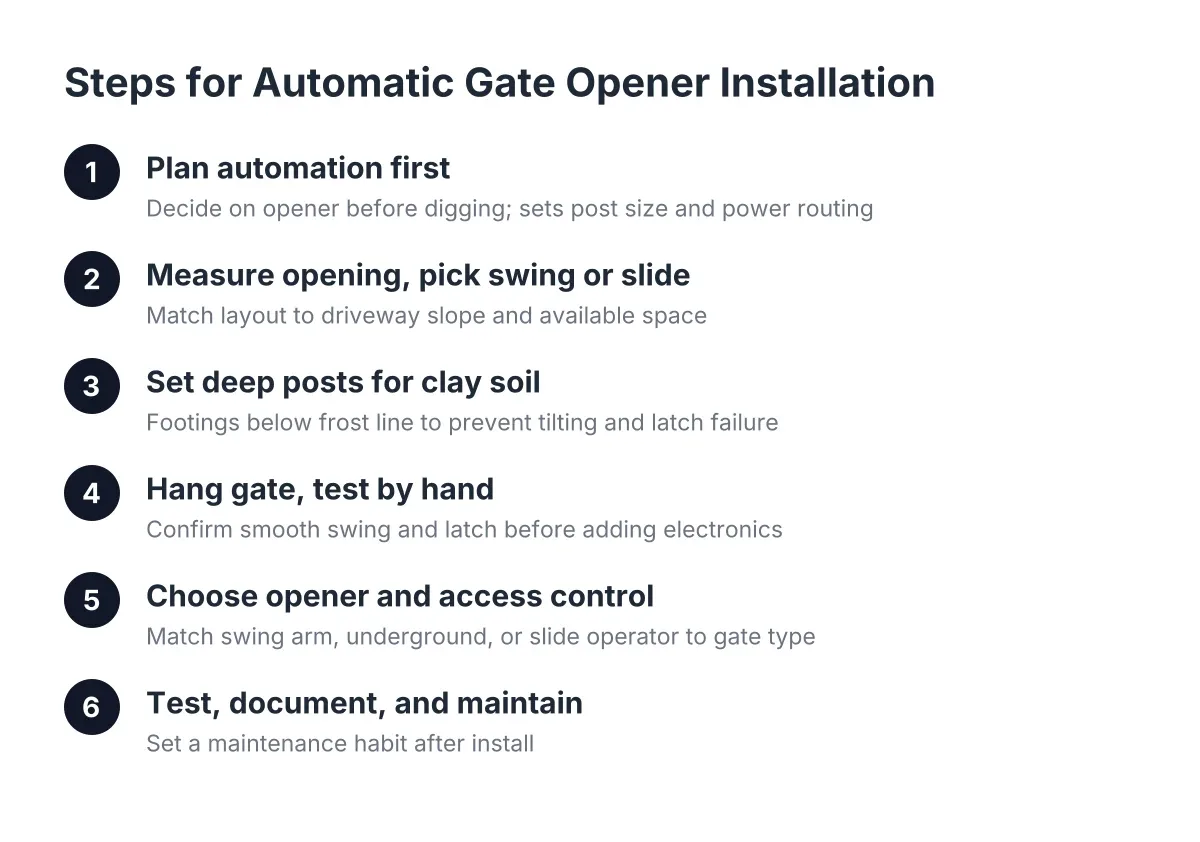
- Dig below the frost line. A footing that sits above the depth where the ground freezes will get lifted by ice forming underneath it. Deeper footings anchor in soil that stays stable all winter.
- Shape the concrete correctly. A footing that is wider at the bottom than the top resists being gripped and lifted by freezing soil. A footing poured with a mushroom top, wider at the surface, gives ice a shelf to push against.
- Manage drainage. Water pooling at the base of a post is the enemy. Grading the soil so water runs away from the fence line reduces how much moisture is available to freeze around the footing in the first place.
Steel and iron posts have a structural advantage here beyond rust resistance. They do not rot, twist, or warp the way wood posts do, so the footing stays loaded evenly year after year. There is a reason crews doing fence repair on older wood fences often cut off a rotted wood post above the bad section and set a new steel post into the original concrete footing. It saves the cost of demolition and reuses a footing that is still sound. Iron fences start with that stronger post from day one.
For the reader who just had a wood fence installed, this is worth filing away. Your fence can give you a long life if the posts were set deep and the drainage is right. But when a wood post eventually fails at ground level, the fix does not have to mean tearing out the whole line. Interim post repairs that preserve the concrete footings keep the fence standing and let that repair money effectively count toward a future replacement with steel posts.
Rust Is the Real Winter Enemy, Not Ice
Cold does not hurt iron. Water sitting on bare iron does. Every wrought iron fence ships or gets finished with a protective coating, usually a powder coat or paint over a primer, and that coating is the entire rust defense. Winter is when that defense gets tested hardest, for three reasons.
First, winter is wet. Chattanooga gets steady seasonal rain, and fences stay damp for days at a stretch. Any scratch, chip, or weld point where the coating has failed stays in contact with water far longer than it would in summer.
Second, freeze-thaw cycles pry at weak spots in the coating. Water works into a hairline chip, freezes, expands, and lifts the coating a little more. By spring, a chip the size of a pencil tip has become a flaking patch with orange rust underneath.
Third, nobody looks at their fence in January. Rust that starts in December gets three or four months of head start before anyone walks the fence line in spring.
The maintenance answer is simple and cheap. Walk the fence once in late fall and once in early spring. Look for chips, scratches, and rust bloom, especially at welds, at the base of pickets, and anywhere the fence meets the ground. Touch up small spots with a wire brush, a rust-inhibiting primer, and matching paint. Ten minutes of touch-up in November prevents the kind of deep rust that eats through a picket base over five neglected winters. That small habit is most of what separates an iron fence that lasts decades from one that looks tired in ten years.
A Tale of Two Fences: An Illustrative Chattanooga Winter
Suppose a small landlord owns two rental houses a few streets apart in East Ridge. Both got new fences the same fall. House one got a wood privacy fence with wood posts set in shallow footings because the crew hit clay and stopped digging early. House two got an iron fence with steel posts set below the frost line in properly flared footings.
Now run both fences through a typical Chattanooga winter: a soaking December, two hard freezes in January, a warm spell, then another freeze in February.
By March, in that scenario, house one has two posts leaning where frost heave lifted the shallow footings, a gate that no longer latches because its post shifted, and boards near the ground that stayed wet all winter and are starting to gray and check. The tenant calls about the gate during a turnover inspection, and the owner is now pricing gate repair before the unit can be re-listed.
House two needs a fifteen-minute walk-through and maybe a dab of touch-up paint on one chipped picket. The fence line is as straight as the day it went in. Nothing about that outcome is luck. It is footing depth, drainage, post material, and an intact finish doing exactly what they are supposed to do.
That is a hypothetical, and plenty of wood fences in Chattanooga come through winter fine when the posts were set right. But it shows where the risk concentrates: at the posts and at ground level, in winter, in clay.
Where Iron Falls Short, Honestly
No material wins everything, and an honest guide says so. A wrought iron fence gives up a few things in exchange for its winter toughness.
- No privacy. Iron pickets have gaps by design. If the goal is screening a backyard or meeting a lease requirement for a contained dog run with visual privacy, a privacy fence in wood or vinyl does that job and iron does not.
- Higher upfront cost. Iron sits at the expensive end of fence materials. For context, Angi puts the national average fence installation at $3,277, with jobs ranging from $1,860 to $4,843 depending on length and material; iron projects tend to land toward the top of a given project's range, while chain link lands near the bottom. For a rental property where the fence just needs to be secure and durable, chain link fence installation often makes more financial sense.
- Repairs need metalwork. A bent or broken iron section usually means cutting, welding, or replacing a panel, not swapping a board. That is a job for someone with the right tools.
- Maintenance is light but not zero. The twice-a-year rust walk is easy to skip, and skipping it for years is how iron fences decline.
One more honest note: if your fence line crosses a slope, sits in a low spot where water collects, or runs through heavy fill soil, get a professional opinion before choosing any material. Drainage and soil problems sink fences of every type, and a site visit catches issues that no article can.
What This Means for the New Wood Fence Owner
If you are reading this a few months after a wood fence installation, you are probably not replacing anything. Good. The lesson from how iron handles winter still applies directly to the fence you have, because the same forces are acting on it.
First, protect your boards the way iron protects itself: with a finish. New pressure-treated wood needs time to dry out before stain or sealant will absorb properly. Staining too early traps moisture and the finish fails fast; waiting too long leaves the wood unprotected through sun and rain. The reliable test is not a calendar, it is the wood itself: sprinkle water on a board, and if it soaks in instead of beading up, the wood is ready to accept stain. In Chattanooga's humidity, that readiness usually takes longer than it would in a dry climate, so test rather than guess.
Second, watch your posts and the ground around them, especially after the first winter. Soil that settled away from a footing, water pooling at a post base, or a gate that suddenly drags are all early signals worth a quick fence repair call before they become a leaning section.
Third, keep the bottom of the fence dry. Water wicking up from the ground into the lowest boards is a leading cause of early rot. A pressure-treated rot board along the bottom edge takes that abuse instead of your pickets and can be replaced cheaply when it wears out.
Deciding Whether Iron Is Right for Your Property
Pull it together and the decision gets clear. Iron earns its price when the fence needs to look good from the street, define a boundary without blocking the view, and shrug off decades of Chattanooga winters with minimal attention. Front yards, pool enclosures, historic-style homes, and commercial frontage are where decorative iron panels make the most sense.
For rental properties where the budget per job is tight and the goal is a secure yard that passes a turnover inspection, chain link or vinyl usually delivers more fence per dollar. According to HomeAdvisor, fence installation runs between $6 and $50 per linear foot depending on material, and that spread is exactly the chain-link-to-iron range in practice. A landlord with several units may put iron on the street-facing frontage of one flagship property and chain link everywhere else, which is a reasonable split.
Whatever material you land on, the winter lesson holds across all of them. In a freeze-thaw climate with clay soil, the fence above the ground matters less than the posts below it. Ask any installer, for iron or anything else, three questions before work starts: how deep do the footings go relative to the frost line, how is the concrete shaped to resist heave, and how will water drain away from the fence line. The answers to those three questions predict how your fence looks in March better than any brochure.
Wrought iron fences perform in Chattanooga winters the way a well-anchored thing should: quietly, without drama, year after year. The material was never the question. The installation always was.
If you need fence installation, Chattanooga Fence Builders can help.
Prefer to talk it through? Call (423) 615-8548 — a quick call is usually the fastest way to get a straight answer for your situation.